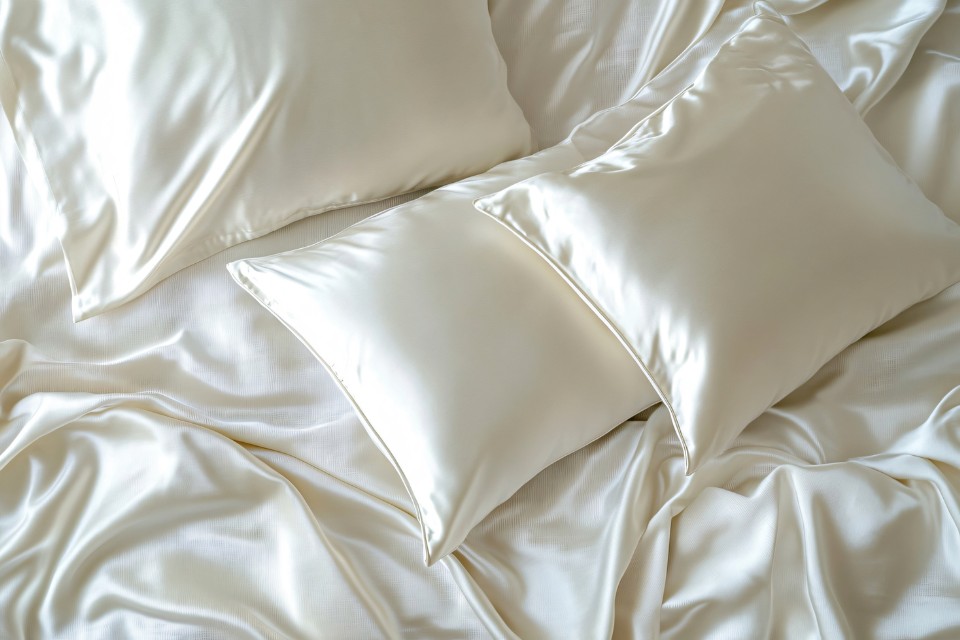
Mulberry silk is the silk made by the Bombyx mori silkworm, fed only on mulberry leaves. Its thread is continuous, and that is where the smooth surface and very low friction come from, the two things you notice in your hair and on your skin. Here is who it suits best, how to care for it and where to start.
The short answer
If your routine relies on the tumble dryer, or you like sheets that feel cool and matte, Egyptian Cotton™ sateen or percale may suit you better. We explain why further down.
What mulberry silk is
Silk is made by the caterpillar of the Bombyx mori moth, which feeds only on mulberry leaves. This is the species that gives the highest quality silk, with even filaments and a clean white.
Unlike cotton and linen, silk is not spun from short fibres. Each cocoon gives one continuous filament, and that is what leaves the fabric surface without texture. It takes around 3,000 silkworms to make one kilo of silk fabric.
Silk is the most premium, most luxurious fabric we have. Silk is the most premium, most luxurious fabric we have. Our silk bedding is woven from 100% mulberry silk and made in Portugal.
Who silk suits
Side sleepers, first of all. Through the night, your face and hair spend hours against the pillowcase. A continuous surface pulls less on hair than a fabric with a visible weave, and leaves fewer creases on your face in the morning.
People with sensitive skin. Mulberry silk is naturally hypoallergenic, so it is a good choice if other fabrics irritate you.
People whose nights swing between hot and cold. Silk regulates temperature and wicks away moisture, so it works both for those who wake up hot and those who go to bed cold.
And anyone who wants a bed that stands out. The natural sheen and smooth feel of silk are unlike any other fabric.
When another fabric may suit you better
Silk asks for some care. It is washed on a delicate cycle at 30 °C at most, and it does not go in the tumble dryer. If your routine relies on the dryer, our 430 thread count sateen in Egyptian Cotton™ has a silky feel and a subtle sheen, and washes at up to 40 °C on a moderate cycle.
If you like cool sheets with a matte feel, our 400 thread count percale in Egyptian Cotton™ is a suggestion that tends to go down well.
If you want the smooth surface of silk in a fabric with the structure of cotton, our cotton-silk combines extra-long staple Supima® cotton with mulberry silk. The cotton brings breathability and strength, the silk a subtle sheen.
You do not have to change the whole bed either. A silk pillowcase covers most of what matters for hair and skin, and it is the simplest way to try it.
Silk and sateen are not the same thing
People mix them up all the time. Silk is a fibre. Sateen is a way of weaving, where the thread passes over several others before going under, and it can be made with cotton, like our Egyptian Cotton™ sateen. Both have a sheen, for different reasons: sateen because of the weave, silk because of the thread itself. Sateen is our bestseller, and silk is the most premium fabric we have.
That is also why silk is not measured in thread count. Silk fabrics are measured in momme, a unit of weight: one momme equals 4.34 grams per square metre, and the more momme, the denser and stronger the fabric.
How to care for silk
1. Wash on a delicate cycle at 30 °C at most, with a mild detergent made for delicate fibres.
2. Do not use bleach or fabric softener.
3. Do not dry clean.
4. Do not tumble dry. Let it air dry.
5. Store it clean and completely dry, somewhere cool, well ventilated and out of direct sunlight.
The instructions for each piece are on its label and in our care guide.
Frequently asked questions
Does a silk pillowcase help your hair?
The continuous surface of silk pulls less on hair than a fabric with a visible weave. For side sleepers, the pillowcase is where the difference shows most.
Is silk good for sensitive skin?
Mulberry silk is naturally hypoallergenic, which makes it a good choice for sensitive skin.
Can silk sheets go in the washing machine?
Yes, on a delicate cycle at 30 °C at most. They do not go in the tumble dryer.
What is the difference between silk and sateen?
Silk is a fibre, sateen is a weave. There is cotton sateen, like our Egyptian Cotton™ sateen, and there is silk woven in different ways.
What is the difference between silk and cotton-silk?
Our silk is 100% mulberry silk. Our cotton-silk combines Supima® cotton and mulberry silk: the cotton gives structure and breathability, the silk a smooth surface and sheen.
What is momme?
It is the unit used to measure the weight of silk fabrics. One momme equals 4.34 g/m², and the higher it is, the denser the fabric.
Is your silk bedding OEKO-TEX certified?
Yes, like all our products.
Oursilk collection has sheets, pillowcases and duvet covers, also as sets. Next to it you will find ourcotton-silk,430 thread count sateen and400 thread count percale, and ourbedding sets bring everything together in the same size. To compare silk with other fibres, ourfabric guide compares seven, and ourcare guide explains how to look after each one.